PFAS Resources
Quick Links
- The enviPath-PFAS package
- Download Biotransformation Reporting Tool (BART)
- BART submission
- Setting for PFAS pathway prediction
Page Contents
Tutorials
- How to use the enviPath-PFAS package
- Browse Compounds
- Search for Precursors
- How to submit biotransformation pathway data (BARTs)
- How to use the PFAS pathway prediction model in enviPath
Information about PFASs in enviPath
Tutorials
How to use the enviPath-PFAS package
Browse Compounds
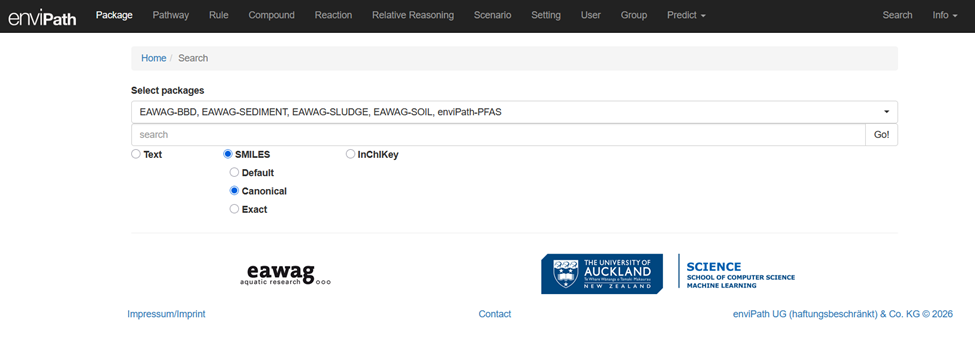
If you are interested in any biotransformation data on a specific PFAS in enviPath, the most effective way to find this information is to use the “Search” tool on the homepage (see screenshot below). This functionality allows users to search for compounds using either text-based names (such as PFHxA) or the SMILES format. Note- make sure that enviPath-PFAS is included under the “Select packages” dropdown box.
Search for Precursors
If a perfluoroalkyl acid such as perfluorohexanoic acid (PFHxA) is detected at a contaminated site, it would be nice to know which polyfluoroalkyl substances could be precursors to PFHxA. To answer this question using enviPath, follow the described steps below.
- Go to legacy.enviPath.org and click on “Package” at the top of the homepage
- Scroll to click on the enviPath-PFAS package, then click on the “Compounds” tab
- Scroll again to find PFHxA, then click to arrive at the compound page for PFHxA (shown below)

Once on this compound page, one can browse the different pathways in which PFHxA exists by clicking on the “Pathways” tab below the structure. One can also explore the individual reaction steps that form PFHxA under the “Reactions” tab. Each of these tabs provides information on which compounds are precursors to PFHxA.
How to submit biotransformation pathway data (BARTs)
Visit the GitHub Repository and download the BART template.
There is a GitHub repository with the BART template that is available to download. You can find this template in the section titled “Download the tool here” (see screenshot of the repository main page below). If you have any questions about the template, or suggestions for improvement, please contact us in the discussion page for this repository.

Upload your data to Zenodo
Once you have finished filling out the BART template, please upload it to Zenodo and generate your own unique digital object identifier (DOI) for the template. This ensures that proper credit will be given to you for your template, and that your data will remain open to the public.
BART files used to generate the enviPath-PFAS package are available on Zenodo at the following links: https://zenodo.org/records/15691214 , and enviPath-PFAS BART Raw Files - Additional BART Files October 2025
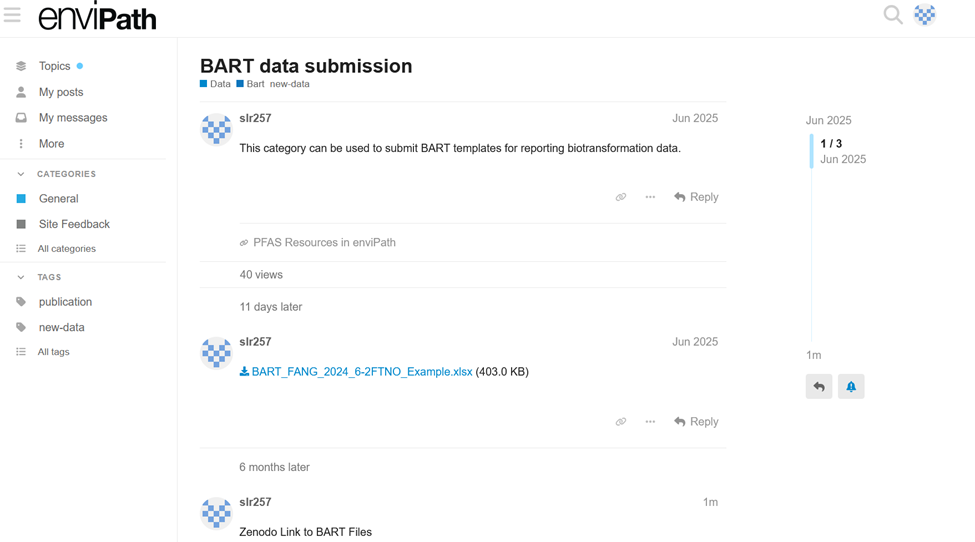
Post a link to your Zenodo repository to the BART submission page in the community forum
Posting the link to your Zenodo repository here in the community forum will notify the enviPath team that you have new data to be reviewed and added to the database. Please post your Zenodo link as a reply to this post in the BART data submission page (shown below).
How to use the PFAS pathway prediction model in enviPath
To predict the possible biotransformation products from any polyfluoroalkyl substance using the PFAS-specific biotransformation pathway prediction model in enviPath, one must first go to the Pathway tab in enviPath, then click Actions > + New Pathway. Then enter the name and SMILES of the compound for which you wish to predict a pathway.
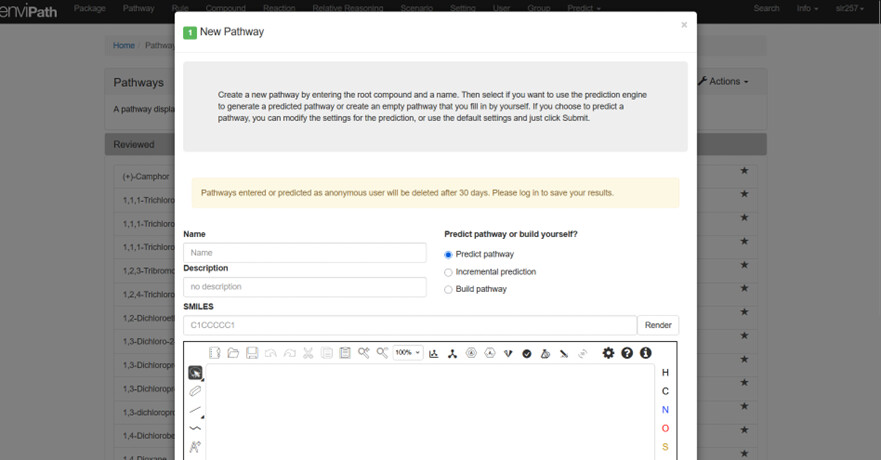
When creating this new pathway, it is important to make sure the option “predict pathway” is selected.
Next, click the “Advanced” button at the bottom of the page. In this box, one must choose “Select Existing” and open the dropdown box to the setting “enviPath-PFAS-enhanced-setting” for predictions.
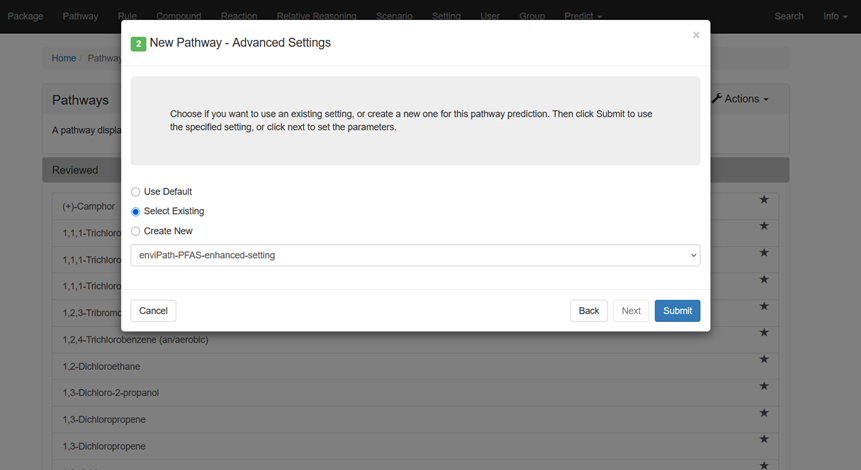
Finally, the user must click the “Submit” button to begin the pathway prediction. Note: the page may need to be reloaded multiple times to show the full pathway. A list of compounds in the pathway can be downloaded in a .csv format by going to the pathway page, clicking “Edit” and selecting “Download Pathway.”
Information about PFASs in enviPath
Per- and polyfluoroalkyl substances (PFASs) are a large and diverse group of synthetic chemicals characterized by strong carbon-fluorine bonds. These bonds make PFASs highly resistant to chemical, biological, and thermal degradation. As a result, PFASs are often referred to as “forever chemicals”. PFASs have been widely used in industrial applications and consumer products such as firefighting foams, non-stick cookware, textiles, food packaging, and surface coatings. Due to their high persistence, mobility, and toxicity, PFASs are detected globally in water, soil, air, wildlife, and humans.
Many researchers have reported that polyfluorinated substances used in aqueous film-forming foams (AFFF) can transform into perfluoroalkyl acids (PFAAs) such as perfluorooctane sulfonate (PFOS) and perfluorooctanoate (PFOA), which are among the most persistent PFASs due to the fully fluorinated nature of all carbons on the molecule. Some examples of polyfluorinated precursors that can biotransform into PFOA in the environment are shown below.
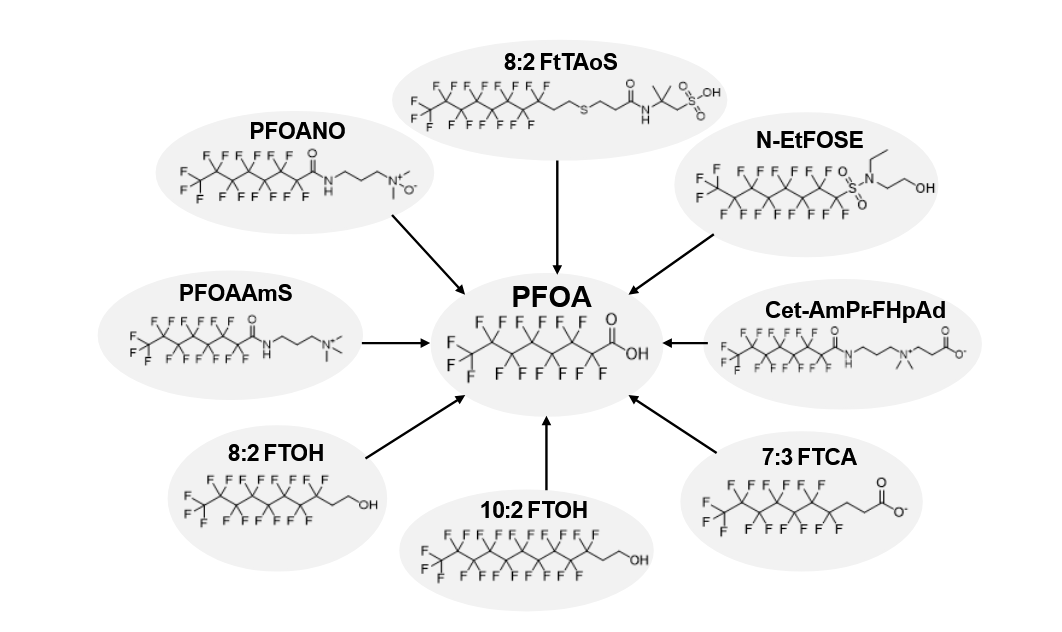
In this figure, eight precursors are shown as nodes leading to the final biotransformation product, PFOA. Although there are eight precursors presented here, this representation does not include all intermediates or other compounds that may biotransform into any of the shown precursors. The enviPath research team has collected and summarized experimental data from 60 peer-reviewed publications on the biotransformation of polyfluorinated PFASs in the environment and generated a FAIR database of biotransformation pathways with associated experimental conditions from these publications.
The enviPath-PFAS database provides users with a method to easily explore these additional intermediates and precursors due to its built-in data structure in which the biotransformation data are stored as interconnected nodes and edges in a graphical reaction network.
For more information, check out our open-access Global Perspective Article - Rich et al 2025.